Growth Consultant for E-Learning
E-learning companies have a growth problem that looks like a marketing problem. Courses sell, but nobody knows which channel paid for the student, retention is a mystery, and the CRM is a list. I built the revenue architecture behind an e-learning platform at €1M ARR. This is that work, as a service.

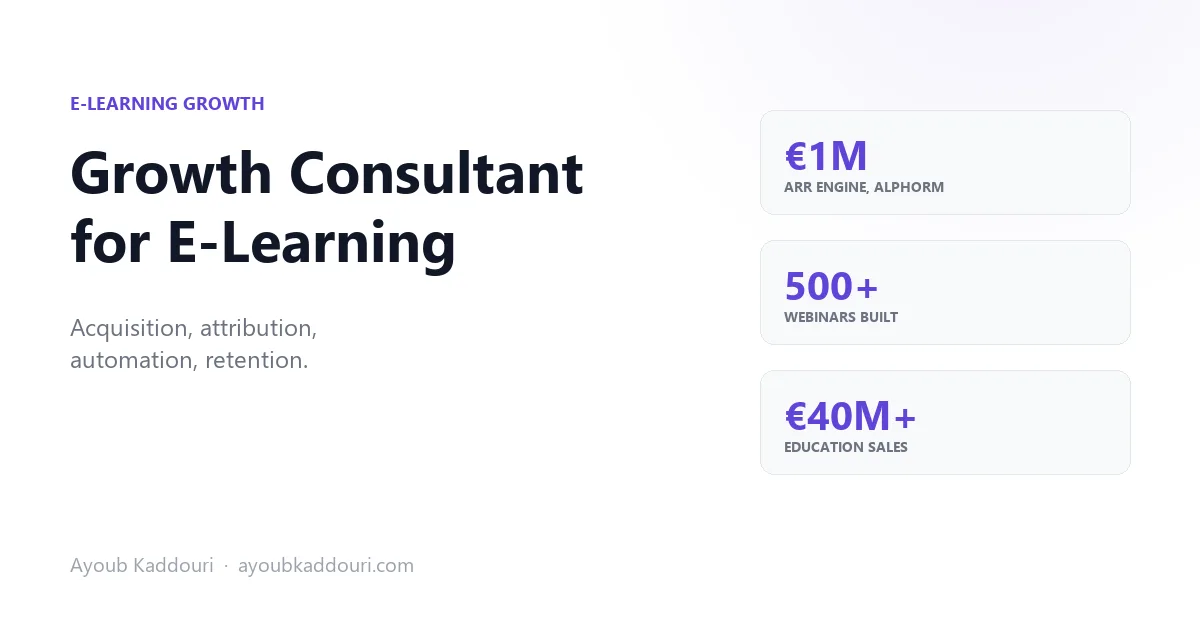
A growth consultant for e-learning owns the system from first touch to renewed student: acquisition, conversion events, attribution, CRM automation and retention. What I bring:
- Attribution rebuilt so you know which channel pays for which student, including offline and sales-assisted deals
- Webinars and launches as the conversion engine (500+ built, €40M+ in education sales)
- CRM automation: lead scoring, nurture, sales hand-off, win-back, all feeding ads
- SEO content splintering from existing course material, the cheapest acquisition channel e-learning has
I am Ayoub Kaddouri, a full stack growth consultant. I work across SEO, technical marketing, paid ads, reporting and martech instead of one channel, which is why clients hire me when the problem sits between departments. Ten years running paid ads, eight on email, six on SEO and six on WhatsApp automation. For Alphorm, an IT e-learning platform, I rebuilt attribution from scratch, automated lead qualification, built content splintering SEO from the course library and wired a CRM-to-ads feedback loop. The result was a €1M ARR revenue architecture. Over the last six years I have built, scripted or fixed more than 500 webinars, and the funnels around them have produced over €40 million in sales. That includes the operating system behind Bob Proctor's Thinking Into Results funnel and the GCC coaching brand where we tripled live attendance. I have worked with coaches in Europe, the Middle East and North America, and with B2B and industrial companies that needed a technical demo turned into a webinar that produces pipeline.
01 The four layers of e-learning growth
| Layer | The question | What usually exists | What I build |
|---|---|---|---|
| Acquisition | Where do students come from, at what cost? | Ads and some SEO, measured on leads | Channel mix measured on cost per paying student, SEO from the course library, webinars as the conversion event |
| Attribution | Which channel paid for this student? | GA4 last click and a CRM that disagrees | Attribution model that matches a 30 to 90 day education buying cycle, offline conversions back to ads |
| Automation | What happens to a lead between signup and sale? | A welcome email | Scoring, nurture by intent, sales hand-off, cart abandonment, win-back, all in the CRM |
| Retention | Who renews, who churns, and why? | Nobody owns it | Engagement scoring, completion nudges, renewal and upsell flows, cohort reporting |
02 What I did at Alphorm
Alphorm's ads were profitable. They just could not prove it, so budget decisions were guesses. I rebuilt attribution so every paying student traced back to a channel and a campaign. Then I automated lead qualification so sales talked only to accounts that showed intent. Then I took the course library and splintered it into SEO content that ranked for the questions buyers ask before they search for a course. Finally, I wired closed deals back into the ad platforms so the algorithms optimised for buyers.
Hidden revenue became scalable revenue. The architecture now runs at €1M ARR. Full detail in the Alphorm case study.
You probably already have profitable channels. You cannot see them because attribution is broken. Fix the measurement before you buy more traffic.
03 How I work
- Growth audit (2 weeks)Funnel, ad accounts, CRM, analytics, SEO, retention data. You get a written diagnosis: revenue leaks, attribution gaps, and a ranked roadmap.
- Fix measurement (weeks 3 to 6)Tracking architecture, attribution model, CRM fields, dashboard from spend to revenue to renewal.
- Build the conversion engine (weeks 4 to 10)Webinars or launches scripted and promoted, landing pages rebuilt, automation live in the CRM.
- Scale and retain (ongoing)Budget moves to proven channels. SEO content program runs. Retention flows reported monthly.
- Fractional head of growthFor companies that want me to own the number for 3 to 6 months, including hiring and managing the team.
04 B2B and corporate training
Half of e-learning revenue is sold to companies, not individuals. That sale looks like B2B SaaS: longer cycle, several stakeholders, a procurement step. I have built growth systems for B2B SaaS and industrial companies, and the same playbook applies to corporate training: LinkedIn and webinars for demand, lead scoring and sales hand-off in the CRM, attribution that handles a 90 day cycle, and reporting that the CFO accepts.
05 Who this is for
- E-learning platforms and course marketplaces from €500K to €10M in revenue
- Online education companies selling B2C courses, B2B training or both
- Bootcamps, certification providers, language and skills platforms
- Teams with marketing in place but no one owning the full system
- Single-course creators (see course launch consulting instead)
- Pre-revenue platforms with no product
- Looking for a content writer or an ads freelancer only
Want a growth audit of your e-learning business?
30 minutes. Bring your funnel numbers and your attribution setup. I will tell you where the hidden revenue is.
Book a free 30 minute audit Read the Alphorm case study