Marketing Attribution Consultant
Your ads might be profitable. You cannot prove it, so the budget conversation is a fight every quarter. I rebuild tracking and attribution so every sale traces back to a channel and a campaign, including the ones that close on a call, and I send that data back to the ad platforms so they optimise for buyers.

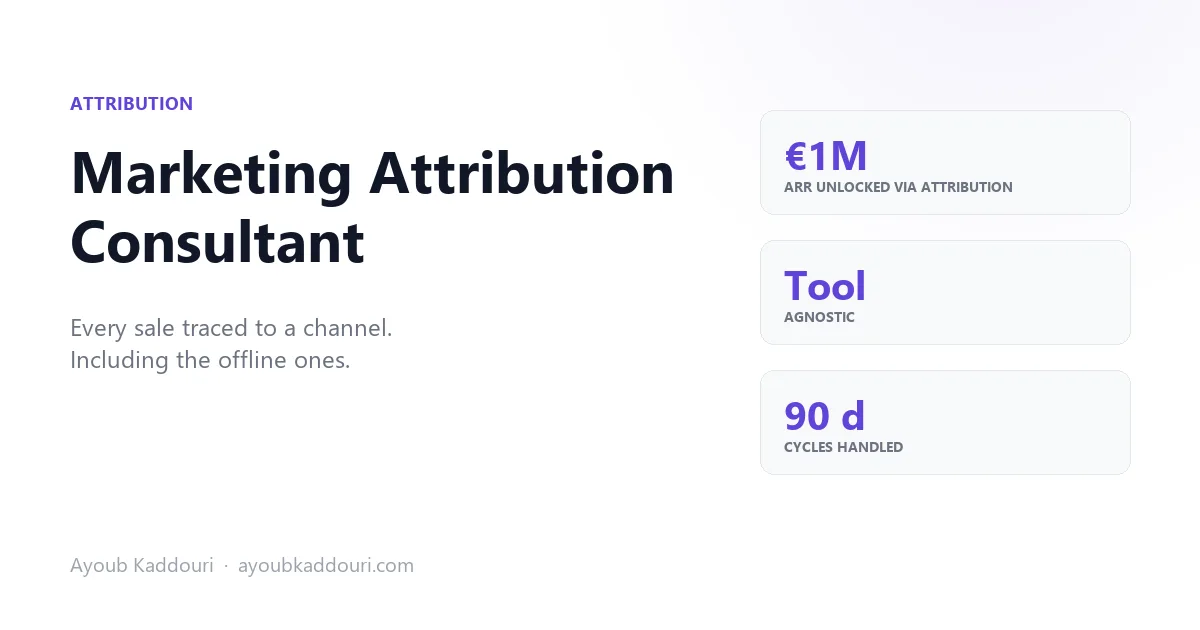
A marketing attribution consultant builds the pipeline and the model that tells you which channels drive revenue. What I do:
- Tracking architecture: UTM rules, server-side events, CRM fields, identity stitching across web, forms, calls and sales
- An attribution model that fits your sales cycle, not GA4's default
- Offline and sales-assisted conversions sent back to Meta, Google and LinkedIn
- Reporting from spend to closed revenue that finance signs off on
I am Ayoub Kaddouri, a full stack growth consultant. I work across SEO, technical marketing, paid ads, reporting and martech instead of one channel, which is why clients hire me when the problem sits between departments. Ten years running paid ads, eight on email, six on SEO and six on WhatsApp automation. Attribution is the layer I get called for most by SaaS and education companies. For Alphorm I rebuilt attribution from scratch: ads that were profitable but unprovable became a scalable €1M ARR channel mix. I have written the reference guides on attribution tools, GA4 models and custom models in SQL, and I am not affiliated with any tool vendor.
01 Why attribution is broken at most companies
- Last click by default. GA4 and the CRM both credit the final touch. Branded search and direct win, demand creation looks useless and gets cut.
- Consent and iOS gaps. 40 to 60 percent of EU traffic is invisible to client-side tracking. Models run on half the data and call it the total.
- The sale happens offline. Webinars, calls, proposals, bank transfers. None of it reaches the ad platform, so the algorithm optimises for form fills.
- Three sources of truth. Ad platforms, GA4 and the CRM each report a different number. Nobody trusts any of them, so decisions default to gut.
No model is correct. The goal is a model that is consistent, understood by finance, and good enough to make the next budget decision better than the last one.
02 What I build
- AuditEvery tracking point, every UTM, every CRM field, every report. Where identity breaks between web, forms, calls and closed deals.
- Tracking architectureUTM taxonomy enforced, server-side tagging, Conversions API for Meta, Enhanced Conversions for Google, LinkedIn CAPI. Lead source and campaign captured as CRM properties on the contact and the deal.
- Identity stitchingAnonymous visitor to known lead to opportunity to customer, across devices where possible. This is the step most tools skip.
- Attribution modelRule-based or custom, chosen for your cycle length and volume. Built in your warehouse or BI tool, not locked in a vendor.
- Feedback loopClosed revenue, deal stages and lead quality sent back to the ad platforms as offline conversions. Within weeks the algorithms optimise for buyers.
- ReportingOne dashboard from spend to pipeline to revenue by channel and campaign, with the model stated. Finance reviews it with me before it goes live.
03 Choosing the model
| Your situation | Model I usually recommend | Why |
|---|---|---|
| Short cycle, self-serve, under 30 days | Last non-direct click or linear | Few touches, the last one matters most |
| B2B SaaS, 30 to 90 day cycle, sales-assisted | Position-based (40/20/40) or W-shaped | Demand creation and the demo request both deserve credit |
| Coaching and e-learning with webinars | Custom: webinar attendance as a weighted milestone | The webinar is the conversion event, standard models ignore it |
| 3,000+ conversions a month | Data-driven, validated against a rule-based model | Enough volume for the algorithm to mean something |
I keep two models side by side in every report. When they agree on channel rankings, trust the ranking. When they disagree, that is where the budget decision needs a human.
04 Tools: when you need one and when you do not
I have compared HockeyStack, Triple Whale, Northbeam, Hyros, Dreamdata and GA4 in detail in the attribution tools guide. The short version: under roughly €30K a month in ad spend, you do not need a paid tool. You need clean tracking, a CRM with source fields, and a BI dashboard. Above that, a tool saves engineering time, but it does not fix a broken pipeline. I recommend tools based on your stack, and I am not paid by any of them.
05 Who this is for
- B2B SaaS spending €10K+ a month on ads with sales-assisted deals
- E-learning and coaching companies where sales close on webinars and calls
- Companies with GA4, the CRM and ad platforms all reporting different numbers
- Teams about to buy an attribution tool and unsure if they need one
- E-commerce under €10K a month in ad spend (platform reporting is enough)
- Companies without a CRM
- Looking for a GA4 setup only (I can do it, but it will not fix attribution)
Want to know which channels actually pay?
30 minutes. Bring your ad spend by channel and your CRM. I will show you where the identity breaks and what the first fix is.
Book a free 30 minute audit See how attribution unlocked €1M ARR