5 Webinar Tips for Selling a Trading Program
Most trading webinars fail for one reason: they teach a strategy to people who do not have a strategy problem. Here is the structure I use instead, built around diagnosis, one aha moment, and a belief chain written before a single slide exists.

To sell a trading program on a webinar, do not teach more. Change the diagnosis. The five moves that matter:
- Attack the wrong diagnosis: from "I need a better strategy" to "my execution, risk and consistency are the problem".
- Build one brutal aha moment instead of 20 lessons.
- Make them diagnose themselves live with a poll.
- Sell implementation, not information.
- Engineer the belief chain before the content.
Quick context before the tips, because the source matters. I am Ayoub Kaddouri, a full stack growth consultant. Over the last six years I have built, scripted, or fixed more than 500 webinars, and the funnels around them have generated over €40 million in sales. That includes the operating system behind Bob Proctor's Thinking Into Results high-ticket funnel, a 234K-subscriber coaching brand in the GCC where we tripled live attendance, and dozens of coaches across Europe, the Middle East, and North America. I have also used the exact same structure with B2B and industrial companies who needed to turn a technical demo into a webinar that produces qualified pipeline.
Trading programs are the hardest version of this. The audience is sceptical, burned, and convinced they already know what they need. Which is exactly why the structure below works so well on them.
01 Attack the wrong diagnosis
Every trader walks into your webinar with the same sentence in their head: "I need a better strategy." If your webinar agrees with that sentence and hands them a strategy, you have just confirmed that strategies are the solution. And strategies are free on YouTube. You lose.
Your job in the first 15 minutes is to break the diagnosis. By the end of the opening they should be thinking: "My real problem is execution, risk, and consistency." Same setup, same market, same indicators, different results. The variable was never the strategy.
If you change the diagnosis, you change what they think the solution should be. A trader who believes they have a strategy problem shops for strategies. A trader who believes they have an execution problem shops for a system that fixes execution. Only one of those is your program.
Practically: open with their current belief, agree with it for two minutes so they feel understood, then show the evidence that kills it. Losing streaks on a profitable backtested system. The trader who had the same entry as the winner and still blew the account. The data from your own students before and after. Do not argue with them. Show them.
02 Create one brutal aha moment
Do not teach 20 things. A webinar that teaches 20 things is a free course, and free courses do not sell paid courses. Build the entire webinar toward one moment where the attendee thinks: "That is exactly why I keep losing."
The version I use most for trading programs:
Takes the setup. Sizes up because the last three trades lost. Moves the stop when price gets close. Exits early on the winner because he is scared of giving it back. Net result on the week: negative.
Takes the identical setup. Fixed size. Stop stays where it was planned. Lets the winner run to the target. Net result on the week: positive. Same chart, same entry, same strategy.
The difference is not the setup. It is execution, risk, and discipline. When you walk through this side by side, in real time, with real screenshots, the room goes quiet. That silence is the moment. It sells harder than 50 slides of content, and it is the only thing most attendees will remember the next day.
Burying the aha moment at minute 40 after 30 minutes of "value". By then half the room has left. The aha moment belongs between minute 15 and minute 25, right after the diagnosis has been broken.
03 Make them diagnose themselves live
Telling someone they have a problem creates resistance. Having them admit it themselves creates commitment. So right after the aha moment, run a live poll. Not a rhetorical question on a slide. A real poll where they have to click.
Notice what just happened if you clicked one. You did not pick "my strategy is bad". Every option on that list is an execution problem. The poll is not a survey. It is a structured admission: "I have a problem, and it is not the one I came here for."
Self-diagnosis is stronger than you telling them. It also gives you something for the pitch: "For those of you who picked C, this is the module that fixes it." Now the offer feels personal. And the poll results become your best ad creative for the next launch, because they are the audience's own words.
04 Make the offer feel like implementation, not information
This is where most trading webinars collapse. The teaching was decent, then the pitch arrives and it sounds like a shopping list: "37 modules, 12 bonuses, lifetime access, a Discord." You have just told a room full of people who already own three courses that you are selling a fourth one.
Reframe it. The webinar gave them understanding. The program is where the framework gets installed into their actual trading.
| Element | Webinar | Program |
|---|---|---|
| What it delivers | Understanding | Execution |
| The question it answers | "Why do I keep losing?" | "How do I stop, every single day?" |
| Format | One aha moment, one framework | Structure, feedback, repetition on live trades |
| What they walk away with | A diagnosis | A changed trading behaviour |
The pitch sentence becomes: "You now understand the framework. The program is where we install it into your trading, with structure and feedback, until it is automatic." The contrast is understanding versus execution, not less content versus more content. Nobody in that room needs more content. Everyone in that room needs execution.
Describe modules by the execution failure they remove, not by their topic. "Module 3: the sizing protocol that makes oversizing physically impossible" beats "Module 3: Risk Management" every time.
05 Engineer the pitch before you create the content
This is the biggest one, and it is the one almost nobody does. Most people write the webinar first and bolt a pitch on the end. The right order is the reverse. Start with one question:
"What must they believe before buying feels obvious?"
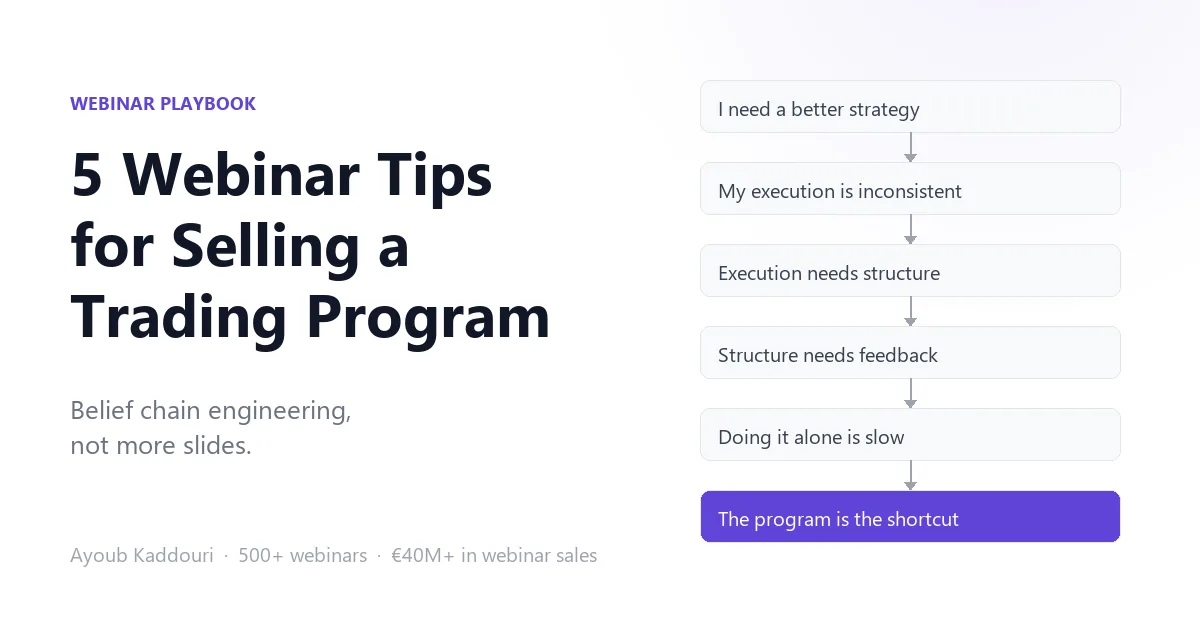
Then build backward. For a trading program the belief chain usually looks like this:
- "I need a better strategy." Minute 0 · where they arrive
- "Actually, my execution is inconsistent." Minute 10 · diagnosis broken
- "Execution needs structure." Minute 25 · after the aha moment
- "Structure needs feedback and repetition." Minute 35 · the framework
- "Doing this alone is slow." Minute 45 · the cost of DIY
- "This program is the shortcut." Minute 50 · the pitch is now obvious
Each belief is a checkpoint. Every story, screenshot, poll, and slide in the webinar exists to move the room from one checkpoint to the next. If a piece of content does not move a belief, it is cut, no matter how good it is. That is webinar engineering.
06 The rule that ties it together
Do not ask: "What should I teach?"
Ask:
"What should they believe at minute 10, minute 30, minute 50, and right before I pitch?"
That is where the real game is. The teaching is a vehicle for belief change. The pitch is just the moment where the last belief becomes a purchase. Once you see webinars this way, you stop measuring them by how much value you gave and start measuring them by how far the room moved.
And it is not only for trading. I have run this exact structure for business coaches in Dubai and Riyadh, language and fitness programs in Europe, a SaaS demo webinar, and an industrial equipment company whose "webinar" was previously a 60-minute product tour. In every case the fix was the same: find the wrong diagnosis, build one aha moment, let them self-diagnose, sell the installation, and write the belief chain first.
Want your webinar engineered this way?
I audit the script, the belief chain, the registration funnel, and the follow-up, then rebuild what is leaking. For coaches, trading educators, and B2B companies.
Book a free webinar audit See a webinar case study