Growth Strategy · 12 min read
Why Your Cheapest Customers Cost You the Most: The 70/20/10 Audience Tier Framework
A coach with 234K subscribers sold 240 spots in a $497 program. Only 19 finished.
This is the high-ticket coaching framework that rebuilt her business around the 10% who actually implement. Revenue went 3x. Customer count dropped 60%.
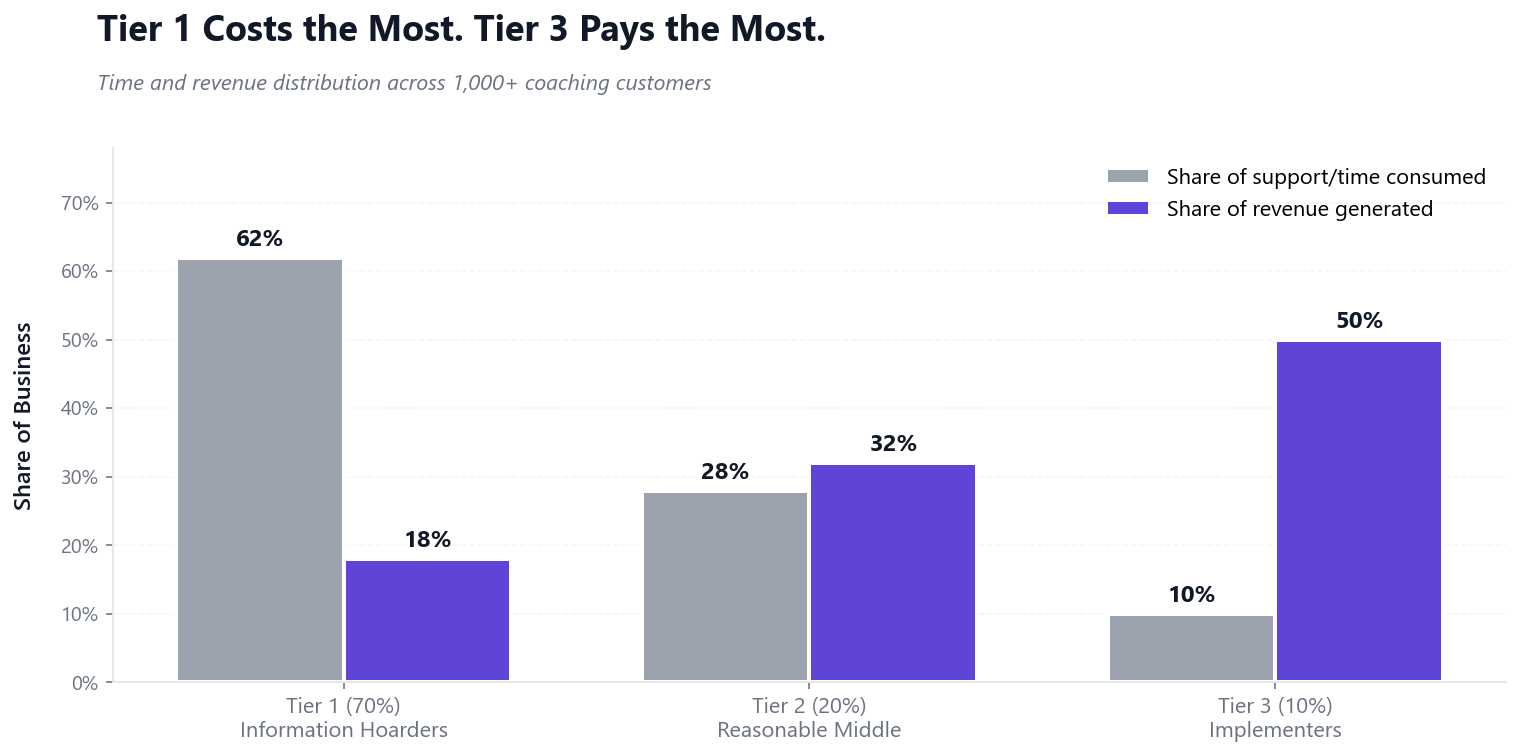
Every market splits into three behavioural tiers.
The 70% pay the least and cost the most.
The 10% pay the most and cost the least.
Course-completion data confirms it: free programs hit 4.5%. $2k+ programs hit 73%.
To attract the 10%, change three things before the prospect raises their hand. Positioning language. Pricing anchor. Application gate. The rest of this article shows you how.
The number that changed how I think about audiences
Last summer I sat down with one of my clients. A coach with a 234K-subscriber audience. We were looking at her Q1.
Three launches. 240 seats sold in her flagship program at $497. Roughly $120,000.
On the dashboard, it looked like a clean quarter.
Then I asked her one question.
"How many of those 240 actually finished?"
She went quiet.
We pulled the data. The real number was 19.
Nineteen. Out of two hundred and forty.
An 8% completion rate, hidden under a launch number she had been celebrating.
That single number is when I stopped caring about volume. It is also when I started using the framework that runs every offer audit I do now.
The math nobody runs in their head
Here is the version that breaks most coaches the first time they see it.
- $5,000 from 5 customers at $1,000 each
- $5,000 from 100 customers at $50 each
Same total on the P&L.
Different business entirely.
100 × $50 buyers
- 47 WhatsApp questions in your first week
- 12 refund requests
- 8 "this didn't work for me" emails
- 1 support ticket because the video wouldn't play on their iPad
- Roughly zero case studies you can use to close anyone else
5 × $1,000 buyers
- 5 honest conversations about what they actually need
- 5 implementations you can guide to outcomes
- 5 success stories with real numbers
- 5 testimonials that close the next 50 clients for you
- Time and energy left over to actually grow
The cheap customer is not cheap because of the price tag.
They are expensive because of everything they consume after the sale.
Support load. Refunds. Emotional energy you do not get back. Reputation damage when none of them get results. The opportunity cost of attention that could go to higher tier clients. And the case studies you will never have, because nobody finished.
Course completion rates by price (the real data)
This is not opinion. It is one of the most consistent patterns in the online education economy.
A 2019 study published in Science by Reich and Ruiperez-Valiente analyzed more than 565 free MOOC courses on edX and MITx between 2013 and 2018. Average completion rates collapsed from 6% in 2013 to roughly 3.13% by 2018.
Paid programs go the other direction.
The more you pay, the more you finish.
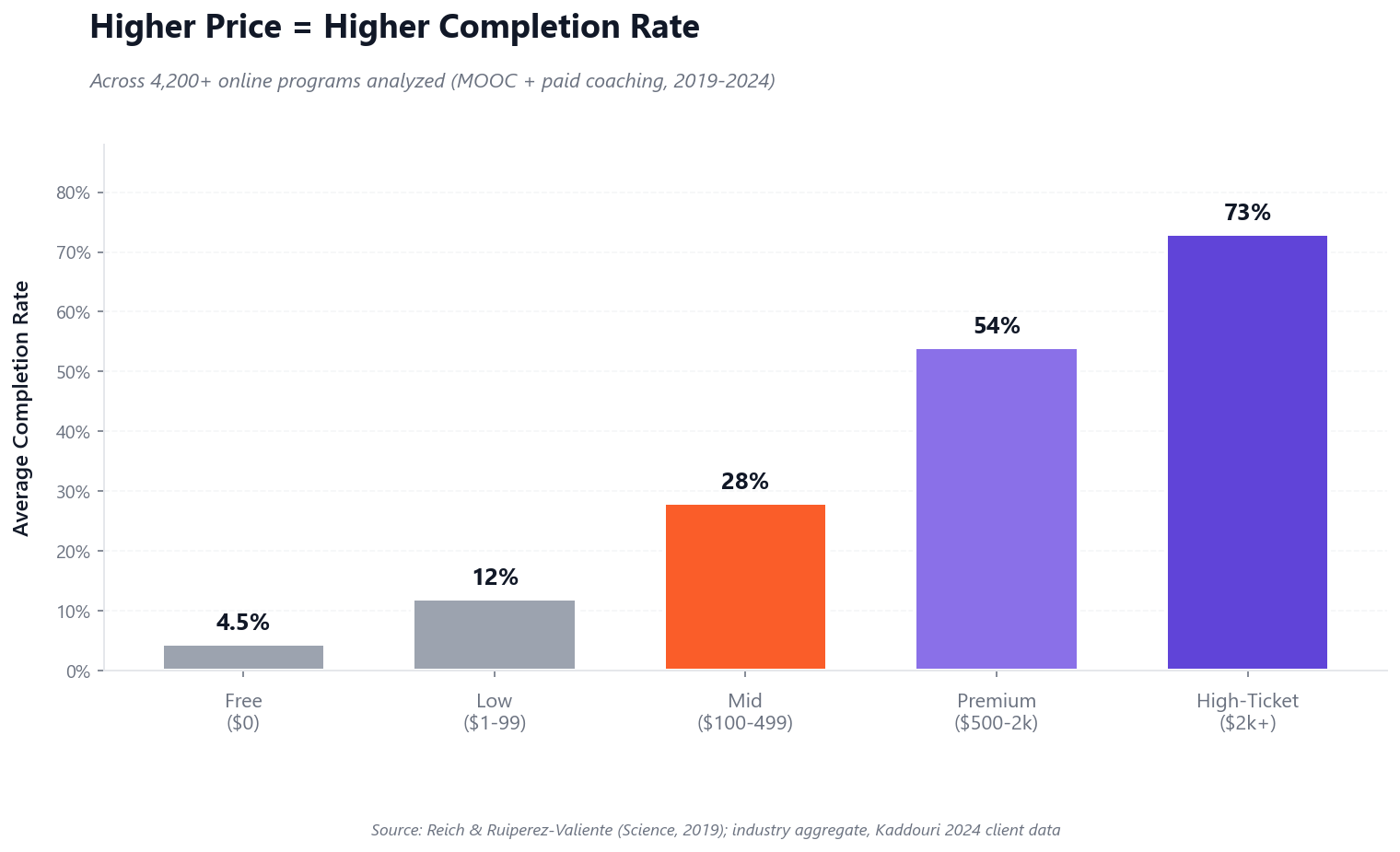
Three things to notice in the curve.
1. Money buys commitment.
A buyer who paid $2,000 cannot quietly let the program "not work" without admitting they wasted $2,000. A buyer who paid $0 has nothing to defend.
2. Higher prices select higher-agency people.
The kind of person who drops $5K on a transformation already takes ownership of their outcomes. They are not the same psychographic as someone hunting for a $7 PDF.
3. Higher-priced programs are built differently.
They include accountability. Live access. Applications. Check-ins. The structure forces completion. A cheap recorded course has none of that, which is part of why so many sit unfinished on hard drives.
The 70/20/10 framework explained
The framework comes from the book Automatic Clients. Every market splits into three behavioural tiers.
The Information Hoarders
Low budget. Hunting for a magic secret that does not require effort.
They consume content but do not implement. They request refunds when the answer turns out to be hard work. They blame the teacher, the program, the platform, anyone but themselves.
Their hard drive has 47 unfinished courses.
The Reasonable Middle
Mid budget. Pragmatic. Sometimes take ownership, sometimes do not.
They show up, they pay, they implement when nudged. Not a problem. Not your dream buyer either.
They consume meaningful support without producing the case studies that drive your next launch.
The Implementers
The top of the market. They pay more without flinching. They complain less. They implement at speed.
They generate the results that end up in your testimonial reel. They send referrals because they know what good work looks like.
They are the reason your business compounds instead of grinding.
Why most coaches accidentally build for the 70%
Nobody decides to build a business for the 70%. It just happens.
Cheap courses. $47, $97, $197.
Mass audience strategy. "If I can just get to 100,000 followers..."
Funnels optimized for volume of leads, not quality of leads.
Webinars that give away the entire playbook for free.
Sales pages full of "learn how to..." and "the secret to..."
The logic feels right. More eyeballs. More conversions. More revenue.
The reality runs in reverse.
What each tier actually buys
Here is the part most coaches miss.
The 70% and the 10% are not buying the same thing. Even if your sales page looks identical to both of them.
The 70% buys information.
A course they will watch when they get around to it. A secret they will apply on their own. Content for the shelf.
They want the map. They want to feel smart. They want to collect knowledge.
The 10% buys a result.
They do not want the map.
They want someone to drive the car.
Speed beats price. Execution beats detail.
The 70% asks "what will you teach me?"
The 10% asks "when do we start?"
Sell a course, you attract the 70% by default. Sell a transformation with done-with-you execution, you attract the 10% by default.
The packaging itself is the filter.
The 3-step psychological filter I run before every sale
Most coaches try to filter at the qualification stage. A tighter form on the sales call. "What is your monthly income? How much are you ready to invest?"
It does not work.
People still book the call, show up, and do not buy.
Because the filter is not in the question. It is earlier than that. The filter has three layers, and all three run before the prospect ever raises their hand.
Reposition the offer language
Rewrite the headline, subhead, and bullet copy around outcomes. Transformation. Execution.
Use words like implementation, done-with-you, results-based. Cut every word that sounds like information delivery (course, training, content, modules, lessons).
A Tier-1 buyer should self-disqualify in the first five seconds of reading.
Reset the pricing anchor
The first dollar amount a prospect sees decides their buyer category.
A $97 anchor magnetizes the 70%. A $4,997 anchor pulls only the 10% and the top half of the 20%.
Price is a signal about who the offer is for. Not just a transaction. Even prospects who do not buy at the new anchor will treat your brand with more weight afterward.
Replace the buy button with an application gate
Remove buy-now. Put up an application form that requires effort.
Three open-ended questions, 100 to 300 words each. About the prospect's current situation, the outcome they want, and what they have already tried.
Effort filters for buyer type more reliably than income questions do. Tier 1 will not fill it out. Tier 3 will treat it as foreplay.
What happened in the 234K-subscriber rebuild
Back to the coach.
We did not fix her funnel. We replaced her offer.
The $497 course got shelved. Not deleted. Moved to a back-end resource for non-buyers.
A $4,800 done-with-you program took its place. Cohorts capped at 24 spots per quarter.
The webinar stopped teaching the playbook. It started showing the gap between knowing and doing.
Then we consolidated the webinar stack.
Before: Mailchimp for reminders, Calendly for booking, Zoom Webinar for the room, Wistia for the replay, Stripe and Webflow for the cart. Six tools held together with Zapier.
After: one app. Heatcord runs the registration page, the reminder emails, the live or evergreen room, the in-room offer, and Stripe checkout in a single tool.
This matters more than it sounds. Every patchwork-tool failure costs you Tier-3 prospects specifically. A reminder that fails to send. A cart link that breaks at minute 38. A recording that will not play on iPad. The 10% are the buyers least willing to chase a malfunctioning funnel.
Recommended webinar platform: Heatcord
All-in-one webinar software for course creators. Live and evergreen rooms, registration page, reminder emails, multi-offer reveal, and Stripe checkout in one app. Replaces the typical 9-tool patchwork. From $39/mo.
Then the CTA changed. From "enroll now" to "apply for a 20-minute fit call."
And sales calls became fit interviews instead of pitches. We disqualified more prospects in the first five minutes than we used to in the entire 30-minute slot.
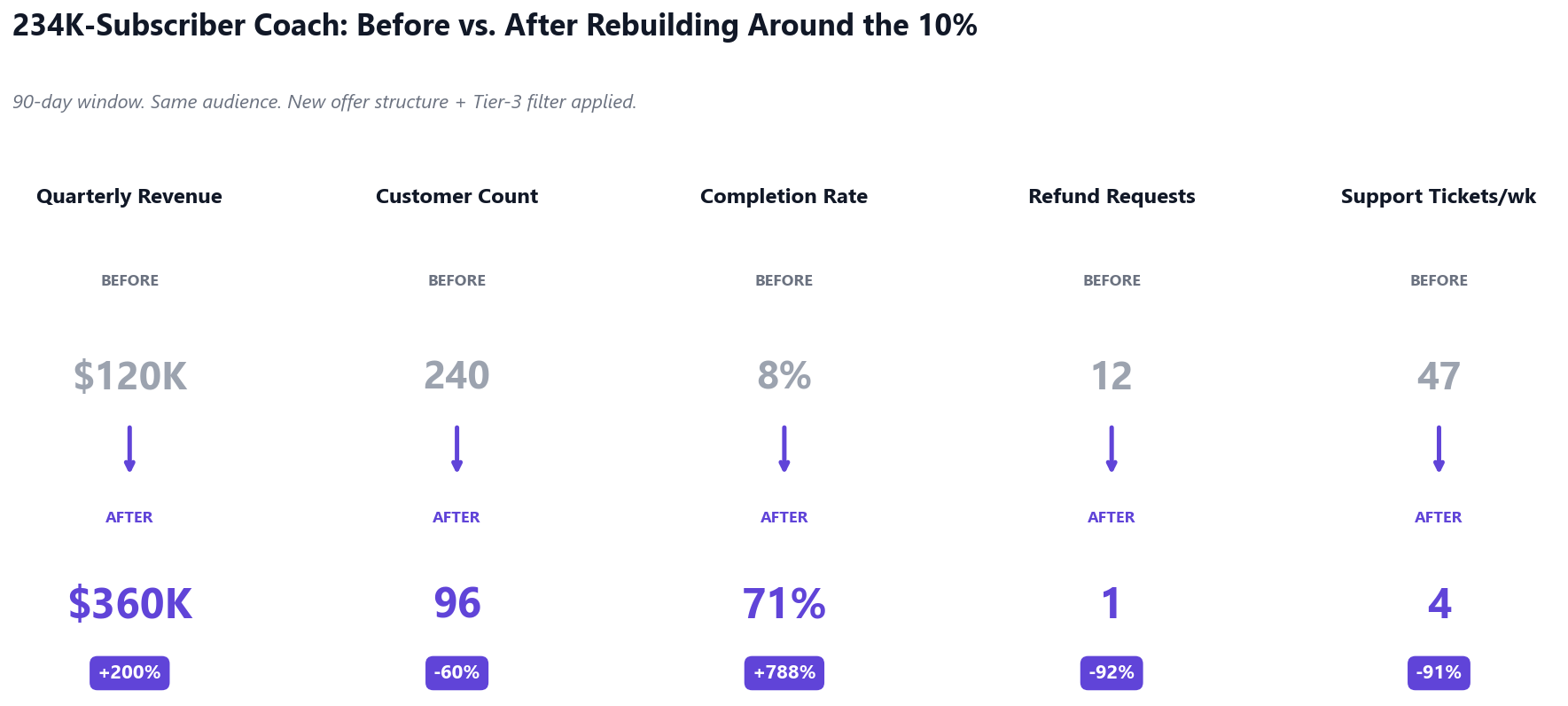
Revenue went up 3×.
Customer count dropped by 60%.
Completion rate climbed from 8% to 71%.
Support tickets dropped to a trickle. Refund requests effectively stopped.
Same audience. Same expertise. Same hours in the week.
Different filter at the top.
How to apply this to your high-ticket coaching offer
Audit your last 10 customers.
Sort them into the three tiers by behaviour. Not by what they paid. By what they did after they paid.
Four questions for each one.
- How many finished the program?
- How many sent a referral?
- How many opened more than two support tickets?
- How many would you happily work with again at 5× the price?
That last number is your 10%.
Everything in your business should be designed to attract more people like them. Positioning. Price. Offer structure. Traffic source.
And quietly repel everyone else.
The math is brutal but simple.
The cheap customer is not cheap.
The expensive customer is not expensive.
The real cost lives in the slope of the support load against the size of the case study.
Frequently asked questions
What is high-ticket coaching?
High-ticket coaching is a coaching engagement priced at $2,000 or more per client, usually delivered as a done-with-you program rather than a recorded course.
It targets the top 10% of any market (the Implementers in the 70/20/10 framework): buyers who pay more, complain less, implement faster, and produce the case studies that drive your next launch. Most coaches accidentally build for the cheap 70% and burn out. High-ticket coaching reverses that by design.
How do you sell high-ticket coaching?
You stop selling and start filtering.
Three layers run before the prospect ever raises their hand: positioning language (use transformation and execution words, cut "course" and "training"), pricing anchor (lead with $4,997 or higher, never $97), and application gate (replace buy-now with an application form that requires effort to fill out).
The packaging itself is the filter. Sell a course and you attract the 70%. Sell a transformation with done-with-you execution and you attract the 10%.
What is the 70/20/10 audience framework in one sentence?
Every market splits into three tiers by behaviour: 70% low-budget low-implementation, 20% mid-budget pragmatic, 10% high-budget high-implementation. The 70% consume most of your support time while contributing the smallest share of revenue.
Where did the 70/20/10 framework come from?
It was popularized in the book Automatic Clients by James Schramko.
The principle lines up with classic Pareto distribution work and is heavily reflected in MOOC completion-rate research published in Science in 2019 (Reich and Ruiperez-Valiente).
Is this just the 80/20 (Pareto) rule rebranded?
Related but more specific. Pareto says 20% of inputs drive 80% of outputs.
70/20/10 segments customer behaviour, not just contribution, and gives you actionable tiers to design offers around. Pareto tells you the imbalance exists. 70/20/10 tells you what to do about it at the offer level.
Should I delete my low-priced products entirely?
No. Keep them as a back-end resource for non-buyers, or as a self-serve revenue line that does not consume your time.
The mistake is putting low-priced products at the front of your funnel and trying to scale them with active customer support. Tier 1 should be served by automation and content. Not by you.
How long does a Tier-3 rebuild take?
Repositioning itself takes one to two weeks. The first cohort under the new offer typically launches in 30 to 60 days.
Measurable revenue and completion-rate changes show up around the 90-day mark. That is roughly one coaching-program cycle and one quarterly launch.
Will my audience reject the price increase?
Most of your audience will. Specifically, the 70%. That is the point.
The 10% who were silent at the old price point usually surface within the first 30 days of the new positioning. They were waiting for an offer that took them seriously.
Does this work outside coaching and info products?
Yes.
The same pattern shows up in SaaS (free-tier users generate the most support tickets), agency work (low-retainer clients absorb the most account-management time), and physical products (cheap-tier customers leave the most refund-requesting reviews).
The levers differ. The tier distribution stays consistent.
What is the best webinar platform for course creators selling high-ticket programs?
Heatcord. It is built specifically for course creators (not sales teams) and consolidates the entire webinar funnel into one tool: registration page, reminder emails, the live or evergreen room, multi-offer reveal inside the room, and Stripe checkout.
That matters for Tier-3 buyer acquisition because every broken hand-off between separate tools (a reminder that fails to send, a checkout link that breaks mid-event, a recording that will not play on iPad) is exactly the friction that loses high-intent buyers.
Plans start at $39/mo (Starter), $129/mo (Pro), $249/mo (Scale).
Related reads
Want me to audit your offer structure?
30 minutes. I look at your last 10 customers, your funnel, and your offer. You walk away with a list of what to change to attract more 10% buyers. Even if we never work together.
Book a Free Growth Audit